

How Often Should Submeters Be Replaced?
Most property managers know their submeters need occasional maintenance. Fewer have a clear answer to the harder question: at what point does a meter stop being worth maintaining and start needing to be replaced?
The answer depends on meter type, age, and what the data tells you. This guide walks through the lifespan you should expect from each type of water submeter, the signs that replacement is overdue, and what Integrity Meter Solutions recommends when it's time to upgrade.
Submeter Lifespan by Meter Type
Not all submeters age at the same rate. The technology inside the meter determines how long it holds accuracy and what kind of attention it needs along the way.
| Meter Type | Typical Lifespan | Primary Failure Mode |
|---|---|---|
| Single-jet mechanical | 3 to 5 years | Accuracy drift from wear |
| Multi-jet mechanical | 8 to 12 years | Gradual accuracy loss |
| Ultrasonic (solid-state) | 15 to 20+ years | Transmitter/electronics |
Single-jet meters are the shortest-lived and the least accurate over time. As we covered in our post on why we don't sell single-jet meters, the internal wear on these meters can cause significant accuracy drift within just a few years. If your property is still running single-jet meters, replacement isn't a question of if but when.
Multi-jet meters are the workhorses of residential submetering. They hold accuracy longer and handle a wider range of flow conditions than single-jet designs. With proper maintenance, a well-made multi-jet meter like those in the Master Meter Multi-Jet line can deliver reliable performance for 8 to 12 years before replacement becomes the right call.
Ultrasonic meters have no moving parts to wear out, which is why their lifespan extends well beyond mechanical meters; as we detailed in our guide to ultrasonic water meters. For most properties, replacing a mechanical meter with an ultrasonic means not thinking about that meter again for a generation.
Maintain, Repair, or Replace: How to Make the Call
The decision isn't always obvious. A meter that's causing problems isn't automatically ready for replacement, and a meter that's old isn't automatically failing. Here's the framework our team uses when evaluating a meter's status:
Maintain if:
The meter is within its expected lifespan for its type
Usage data is consistent and reconciles with master meter totals
No billing disputes have been tied to that unit's readings
The last service visit found no hardware issues
Repair if:
A transmitter or communication component has failed but the meter body is sound
A connection has loosened or a seal has degraded on a meter that's otherwise within its lifespan
A firmware or configuration issue is causing data gaps in an otherwise functional system
Replace if:
The meter has exceeded its expected lifespan for its type
Usage readings are drifting low or inconsistent and recalibration hasn't resolved it
A billing dispute was traced back to meter inaccuracy
The meter is a single-jet design regardless of age
Repair costs are approaching the cost of a new meter
The meter is incompatible with your current AMR system and an upgrade is needed
Our submeter maintenance service includes a data review before every site visit, which means our team arrives already knowing which meters are showing signs of age. In most cases, we can tell you whether a meter needs service or replacement before we've touched it.
Warning Signs a Submeter Is Ready for Replacement
Some meters announce themselves. Others fail quietly for months before anyone notices. Here are the signs to watch for:
Readings that consistently run low compared to historical usage for that unit, often the first sign of mechanical wear on an aging meter
A unit showing zero usage despite being occupied, which typically means a failed transmitter, though it can also indicate a meter body failure
Master meter totals that don't reconcile with the sum of unit submeter readings, particularly when the gap is growing over time
Repeated service calls on the same meter without a lasting resolution
A meter that's been in service longer than its expected lifespan, even if it appears to be reading normally
That last point is worth underscoring. A meter that appears to be working isn't necessarily accurate. Mechanical meters lose accuracy gradually, often without any single reading that flags the problem. The only reliable way to know is a professional evaluation. Our team covers this in detail in our guide to water submeter maintenance.
What Integrity Meter Solutions Recommends for Replacement
When a meter is ready to be replaced, the replacement decision is also an upgrade opportunity. Here's how we approach it depending on the property and the application:
For standard residential submetering: Next Meter NM4-I
When a property is replacing aging mechanical meters, our first recommendation is the Next Meter NM4-I. At $115, it's a 3/4" polymer ultrasonic meter with an integrated transceiver built specifically for submetering applications. No moving parts means no accuracy drift over time. The integrated AMR transceiver eliminates the need for a separate add-on transmitter and connects natively to the NextCentury platform. For a property replacing a full set of mechanical meters, this is the upgrade that removes the replacement cycle from the calendar for the next 15 to 20 years.
For like-for-like mechanical replacement: Master Meter Multi-Jet line
When a property needs a reliable mechanical replacement without moving to ultrasonic, the Master Meter Multi-Jet line is our recommendation. These meters exceed the AWWA C708 standard, detect flow as low as 1/8 gallon per minute, and are built to handle the particulates and buildup that cause problems in older plumbing systems. Options include:
5/8" x 3/4" Direct Read ($108)*, standard residential replacement
5/8" x 3/4" Pulse ($156)*, for AMR-compatible installations
5/8" x 3/4" FAM 3G ($275)*, for properties requiring full AMR integration
1" 3G ($546)*, for larger residential or light commercial lines
For commercial applications: M&E PD line
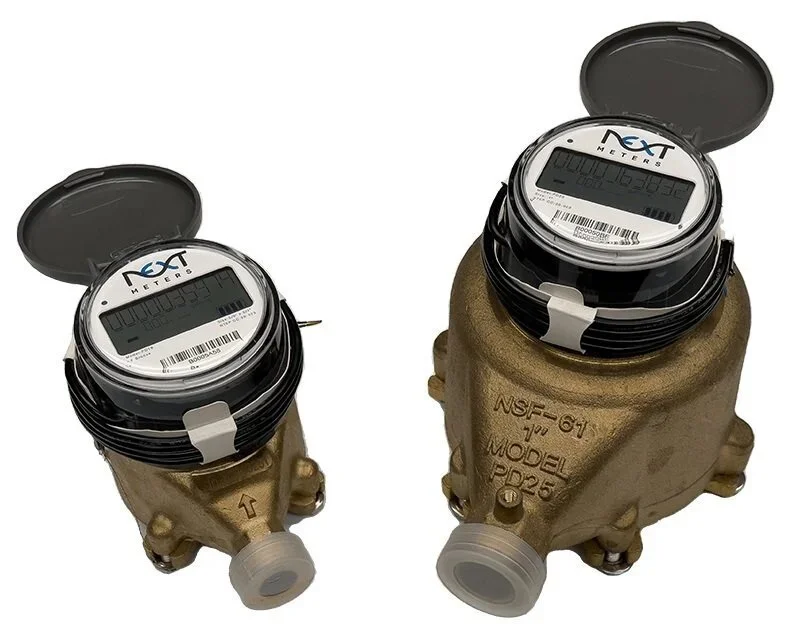
Commercial properties with 1.5" and 2" lines need meters built for higher flow demands. The M&E PD line covers these applications with lead-free bronze construction and encoded NR registers for AMR compatibility:
M&E PD19 5/8" x 3/4" ($187.50)*, smaller commercial lines
M&E PD25 1" ($315)*, mid-range commercial
M&E PD50 2" Threaded ($847.50) or Flanged ($960)*, larger commercial applications
Not sure which meter fits your property's pipe size and configuration? Give us a call and we can help determine exactly what's needed before any equipment is ordered.
How Replacement Fits Into a Maintenance Program
Replacement shouldn't happen reactively. By the time a meter has failed visibly, it's likely already been affecting billing accuracy for months. A proactive maintenance program catches meters that are approaching end of life before they cause problems, and it gives you the opportunity to plan replacements on your schedule rather than theirs.
At Integrity Meter Solutions, our maintenance visits include a usage data review that tracks meter performance over time. When a meter shows patterns consistent with age-related drift, we flag it well before it becomes a billing issue. That's a different outcome than waiting for a tenant dispute to surface the problem.
Not sure where your meters stand? Schedule a submeter maintenance visit and our team will evaluate your system, identify any meters approaching end of life, and give you a clear replacement plan. Or browse our full water meters selection if you already know what you need.
Frequently Asked Questions
How often should water submeters be replaced?
It depends on the meter type. Single-jet mechanical meters typically need replacement within 3 to 5 years. Multi-jet mechanical meters last 8 to 12 years with proper maintenance. Ultrasonic meters can remain accurate for 15 to 20 years or more. Age alone isn't the only factor. Usage data, billing history, and a professional evaluation all inform the replacement decision.
What happens if I don't replace an aging submeter?
An aging mechanical meter typically drifts low in accuracy, meaning it undercounts water usage. The result is that the property absorbs utility costs that should be billed to the tenant. Over time, the gap compounds across every billing cycle. Beyond the financial impact, inaccurate meters can create liability if a tenant challenges the billing data.
Can I replace just one meter or do I need to replace all of them at once?
You can replace individual meters as needed. However, if a property's meters are all the same age and type, it often makes sense to plan a phased replacement program rather than replacing them one by one as they fail. Our team can help you build a replacement schedule based on your meters' current condition and age.
Is replacing a submeter the same as a new installation?
A replacement is simpler than a new installation because the plumbing connections are already in place. The process involves removing the old meter, fitting the new one, and configuring it to the AMR network. Our submeter installation service handles both new installs and full replacements.
Should I upgrade to ultrasonic when I replace my mechanical meters?
In most cases, yes. The price difference between a quality mechanical meter and an ultrasonic meter has narrowed significantly, and the lifespan difference is substantial. A property that upgrades to ultrasonic at replacement time eliminates the next replacement cycle entirely. Our guide to ultrasonic water meters covers the full comparison in detail.
How do I know which replacement meter is right for my property?
Meter selection depends on pipe size, flow rate requirements, existing AMR infrastructure, and whether you're doing a like-for-like replacement or upgrading technology.
*prices current as of August 14, 2026.